
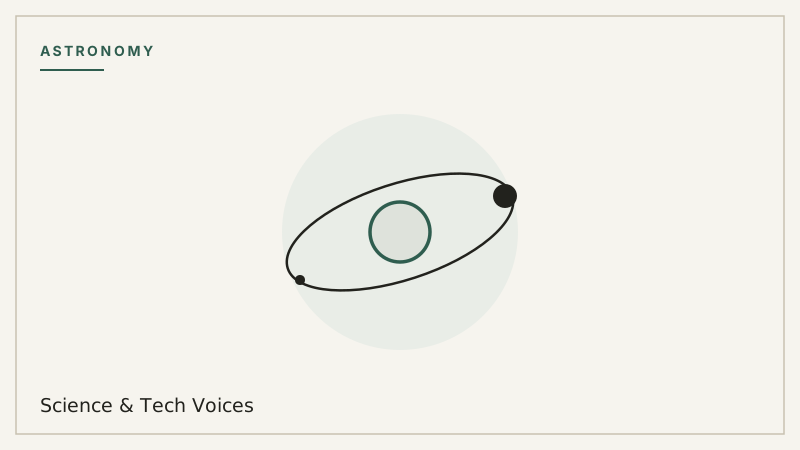
Thirty years ago, we did not know with certainty whether any planets existed beyond our solar system. Today, astronomers have confirmed more than 5,800 of them: scorching gas giants, lava worlds, planets orbiting two suns, and a growing list of rocky worlds at just the right distance from their stars for liquid water. The exoplanet revolution is one of the fastest scientific transformations in history.
How Do You See a Planet You Cannot See?
Planets do not shine; they are billions of times fainter than the stars they orbit. So astronomers learned to detect them indirectly. The transit method watches a star for tiny, regular dips in brightness, the shadow of a planet passing in front. The radial velocity method measures the star's subtle wobble as an orbiting planet tugs at it.
NASA's Kepler space telescope, which stared at a single patch of sky for nine years, used transits to discover thousands of planets at once, and proved something remarkable: planets are not rare. On average, every star in the night sky has at least one.
The Habitable Zone
Around every star there is a band of distances where a planet's surface could be warm enough for liquid water, not boiled away, not frozen solid. Astronomers call it the habitable zone. Dozens of known rocky planets sit inside it, including some around stars close enough to study in detail. The TRAPPIST-1 system, just 40 light-years away, packs seven Earth-sized planets around a single small star, three of them in the habitable zone.
Sniffing Alien Air
Finding a planet is no longer the hard part. The frontier now is studying atmospheres. When a planet transits its star, a trace of starlight filters through its atmosphere, carrying chemical fingerprints. The James Webb Space Telescope reads those fingerprints and has already detected water vapor, carbon dioxide, and methane on distant worlds.
What scientists are really hunting for is a biosignature: a combination of gases, like oxygen together with methane, that chemistry alone struggles to explain. No confirmed biosignature has been found yet. But for the first time in human history, the instruments capable of finding one are actually operating.
Final Thoughts
Every generation believed it lived at a special moment. Ours might genuinely be the one: the first generation with a realistic chance of learning whether life exists beyond Earth. Whatever the answer turns out to be, life everywhere or silence, it will be one of the most profound discoveries our species has ever made.