The scientific world has spent centuries improving the way we process information, from the abacus to transistors, from massive supercomputers to smartphones that fit in our pockets. Now, we stand at the edge of a new era: the age of quantum computers. But why is this technology seen as a “gateway to the future”?
1. The Limits of Classical Computers
Classical computers process information using bits that represent either 0 or 1. Every operation depends on combinations of these two states. This system has brought us the internet, artificial intelligence, and space simulations. Yet, for tasks such as modeling complex chemical reactions, predicting the weather with high accuracy, or analyzing massive datasets instantly, classical computing power is beginning to fall short.
2. The Logic of the Quantum World
Quantum computers are based on the strangest yet most powerful branch of physics: quantum mechanics. Here, the unit of information is the qubit (quantum bit). A qubit can represent both 0 and 1 simultaneously, a property called superposition.
Moreover, through entanglement, qubits can become linked so that the state of one instantly affects the other. This enables massive parallel computation power, allowing quantum computers to solve problems in seconds that would take classical systems thousands of years.
3. Real-World Applications
The impact of quantum computers will extend far beyond research labs:
- Drug discovery: Molecular interactions can be simulated at the quantum level, drastically speeding up the development of new medicines.
- Cryptography and cybersecurity: Quantum computing could break traditional encryption, but it could also create more secure quantum communication systems.
- Finance and logistics: Complex prediction models, risk analyses, and route optimizations could become far more efficient with quantum algorithms.
4. Challenges and Realities
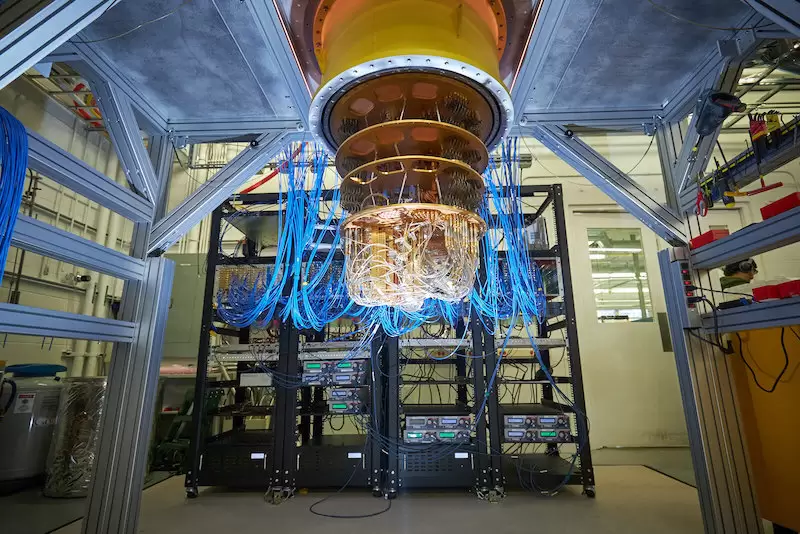
Of course, this technology is still in its infancy. Qubits are extremely delicate: temperature, vibration, or even electromagnetic noise can disrupt their states. Programming quantum algorithms is also far more complex than coding for classical machines.
Still, tech giants like Google, IBM, and Intel, along with many universities, are investing heavily to overcome these hurdles. Since Google’s 2020 experiment demonstrating “quantum supremacy,” progress has accelerated rapidly.
5. Looking Ahead
Quantum computers are not just faster machines; they represent a shift in how we understand the universe. Who knows? Within a few decades, a quantum computer might be optimizing its own algorithms to help humanity solve its greatest challenges.
We’re still at the beginning, but the direction is clear: the future is being shaped in quantum hands.